

Neural tube defects in England and Wales fell dramatically from the 1960s to around 1990 then plateaued. Why?
Dr Clare Craig
| Key points |
| Total NTD pregnancy prevalence in England and Wales fell from 3.7 per 1,000 births in 1964 to 1.6 per 1,000 in 1990, a fall of 57 percent. From 1990 to 2004 the figure plateaus. |
| Government advice for women to take folic acid in anticipation of pregnancy began in 1992. |
| The number of affected births fell much further, from 3.7 to 0.3 per 1,000 because of increasing terminations. By 1990 around 80 percent of identified NTD pregnancies were ending in termination. |
| Four later independent datasets covering England, Wales, Scotland and Europe found no significant change in total prevalence from the early 1990s onwards. |
| The British decline was largely over before folic acid policy began. |
Neural tube defect births in England and Wales have almost vanished. In the mid-1960s roughly 1 baby in every 270 was born with anencephaly, spina bifida or encephalocele. By 2004 the figure was closer to 1 in 3,300. The question is what caused that change and when.
Births or affected pregnancies
A birth prevalence figure counts the babies delivered but it excludes the terminations. With the development of new tests, the proportion of affected pregnancies which were terminated rose steeply through the late 1970s and 1980s. By 1990 it had reached about 80 percent and has remained that high since.
A falling birth count could mean fewer affected pregnancies but it could also mean no change in pregnancies just more terminations. There is a data series for England and Wales which includes terminations and covers the period from 1964 to 2004.
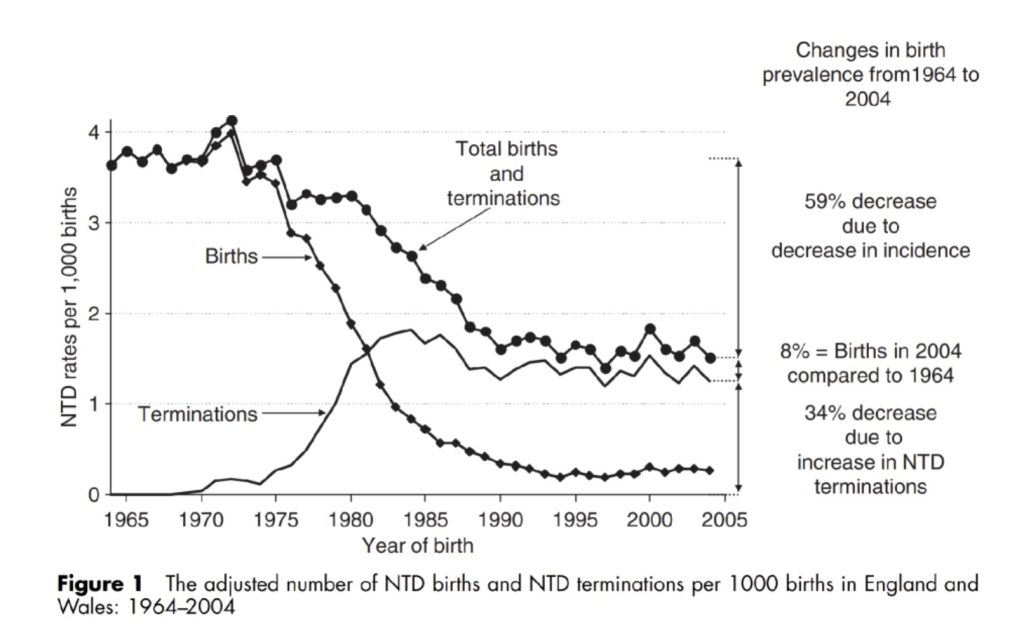
The upper line on the graphs shows the total affected pregnancies i.e. births plus terminations plus late fetal losses. The researchers adjusted the termination data to account for 56 percent not being recorded as being due to a neural tube defect – in 1964 it was 3.7 per 1,000. It then drifts up slightly to around 4.1 in the early 1970s, and then falls almost continuously from the mid-1970s. By 1990 it is 1.6 per 1,000.
The Department of Health issued its advice that women planning a pregnancy should take folic acid in 1992, following the MRC Vitamin Study published the previous year. From that point the line plateaus.
That same plateau has been recorded by eight congenital anomaly registers in England and Wales, a national Scottish study and twenty-eight EUROCAT registries across nineteen countries. All these countries gave advice to take folic acid from 1992.
What caused the fall?
The authors of the study that produced the graph, Morris and Wald, proposed rising dietary folate as one explanation for the decline in incidence but the evidence to support that is poor. Voluntary fortification of some breakfast cereals began in the mid-1980s, too late for the start of the fall.
Given that the great British reduction in neural tube defects had already happened before the folic acid policy began it cannot have been the policy that was driving the fall. Something else must have been changing that was reducing the risk. The reality is that the cause of neural tube defects is complex and dietary folate is an inadequate explanation.