Part 3:
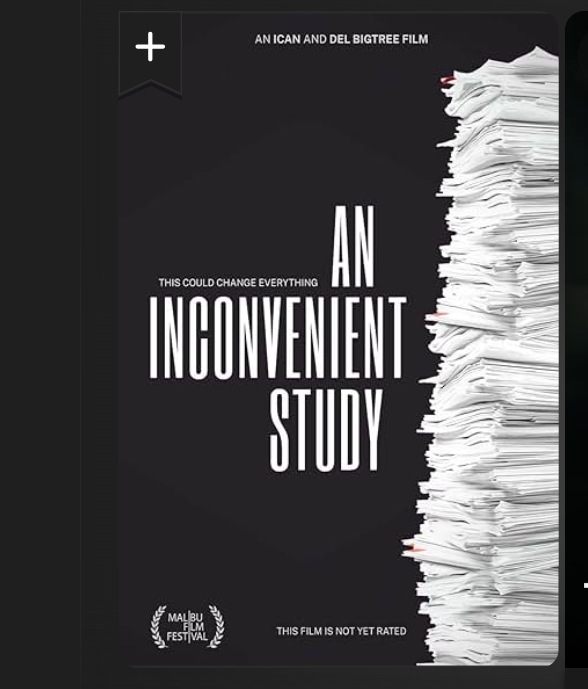
An Inconvenient Study
An ICAN and Del Bigtree Film
The article below, by HART member Dr Gary Sidley, was first published on his Substack page. Members of HART doubtless have views on children’s vaccines ranging from ‘all good’ to ‘all bad’ but one thing we definitely agree on is the importance of sharing data honestly and transparently. The cover up exposed in this film should be a wake-up call to all those still following ‘the science™’. Well worth watching.
In this, the third (and final) article highlighting scholarly commentaries that debunk the dominant narrative about ‘safe and effective’ vaccines, I will summarise the main take-home messages from the film, ‘An Inconvenient Study’ by Del Bigtree. The two previous pieces in this series explored the contents of the books, ‘Dissolving Illusions’ and ‘Can You Catch a Cold’. If the key pieces of information from these three sources were more widely known, the current pandemic industry would be terminally undermined.
Part III: An Inconvenient Study – Del Bigtree

KEY FACTS:
- Since the 1980s, there has been a huge increase in the number of kids with chronic diseases.
- Vaccination often seriously damages babies and children, inflicting unimaginable tragedies upon families.
- No vaccine has ever been properly tested in a doubled blind, placebo-controlled trial.
- A uniquely large study found that vaccinated children were significantly more likely to get sick than the unvaccinated children.
- Despite initial promises to the contrary, the lead researcher of said study refused to publish, stating there is a ‘political agenda’ against disseminating any work that demonstrates vaccine harms/ineffectiveness.
Del Bigtree – an American medical journalist, TV producer, and CEO of the campaign group, ‘The Informed Consent Action Network’ – has created an 80-minute film that will evoke powerful emotional reactions in all who watch it. Those people who are staunchly pro-vaccine will, I suspect, avoid viewing ‘An Inconvenient Study’ and, if they ever should hear about it, will dismiss the film as the work of an ‘anti-vaxxer’. The more open-minded will be shocked, and will subsequently be more inclined to find out more about why we routinely inject our healthy babies and children with multiple chemicals concocted by the profit-orientated pharmaceutical industry. As for parents, I anticipate the film will trigger concern (and maybe resentment) in those who have had their children vaccinated without any negative sequelae; as for those whose offspring have suffered adverse consequences, their reactions will be unimaginable.
Key fact 1: Since the 1980s, there has been a huge increase in the number of kids with chronic diseases.
It is increasingly recognised that the incidence of childhood chronic disease (such as autism, asthma and allergies) is on the rise. The film highlights an astounding statistic: in 1970, the prevalence of autism in American children was 1-in-10,000; it is now 1-in-31. Taking these enduring childhood illnesses as a whole, over 54% of minors are currently afflicted. In the words of Del Bigtree, in the last 40 years ‘we have seen the greatest decline in human health ever recorded’.
This huge escalation cannot be attributed to genetic changes as the rise has been too rapid. Therefore, one must ask the pressing question: what is causing this plague of sickness in millions of our kids?
Key fact 2: Vaccination often seriously damages babies and children, inflicting unimaginable tragedies upon families.
A strong candidate as to the main causative factor for this scourge of childhood sickness is, of course, vaccination. In the US, if parents follow the official public health guidance, each child will have received 72 doses of vaccine by age 18. As for the UK, anyone born after the 1.1.26 should – according to the government’s ‘Routine Vaccination Schedule’ – have absorbed around 30 doses of vaccines, delivered in 16 jabs, by the time they reach their mid-teens; significantly more if they submit to annual flu vaccination.
Most of us – particular those who have critiqued recent public health policy – will be familiar with the plights of the vaccine-injured. But this film conveys the misery and despair of the families of jab victims in a uniquely powerful way. There is something immensely unsettling about watching distraught parents, riddled with guilt about their decisions to vaccinate and re-vaccinate their offspring, describe the transformations observed in their healthy children in the immediate aftermath of inoculation:
– ‘projectile vomiting’
– ‘loss of all language skills’
– ‘seizure-like activity’
– ‘160-degree fever’
– ‘choking on own vomit when lying horizontal’
– ‘he just stopped talking’
– ‘she died in my arms’
– ‘they killed my daughter’.
The stories of two bereft families are especially haunting. A young man called Colton, a fanatical Raleigh-cross cyclist, was paralysed by the HPC vaccine when aged 13. Breathing with the aid of a transportable iron lung, he tells his interviewer how ‘it sucks not being able to play sports anymore’, each word visibly stinging his guilt-ridden mother standing by his side. We later learn that, at 18 years of age, Colon took his own life, believing that he had become too much of a burden for his family.
A second personal story is unforgettably poignant. We are introduced to baby triplets, Ricky, Robbie, and Claire. Beautiful, vibrant, interactive; the trio are testimony to the miracle that is the human form. In the words of their mother, ‘Everyday of our life was a party’.
Then along came the pneumococcal vaccine.
On the day of inoculation, all three of these gorgeous infants were robbed of their life force, transformed into severely autistic toddlers. Within hours of the jab, Claire acted ‘as if she was blind and deaf, and all she did was stare at the ceiling … stopped blinking, stopped yawning, stopped coughing, stopped sneezing’. Shortly afterwards, her two brothers also shut down. All the triplets were sentenced to lives devoid of normal language development. Eight years later, one child remains incontinent, while another displays severe obsessive-compulsive symptoms. The before-and-after pictures of the triplets will remain etched on my mind for a very long time.
Key fact 3: No vaccine has ever been properly tested in a doubled blind, placebo-controlled trial.
We are repeatedly told by healthcare professionals, and representatives of the pandemic industry, that vaccines are ‘safe and effective’, a mantra intended to reassure parents that the plethora of chemical agents routinely inserted into the delicate bodies of their children will result in more benefits than harms. The film addresses the question of vaccine safety (rather than effectiveness) and highlights the shocking fact that none of the multiple vaccines on the routine inoculation schedule has ever been properly tested in a double-blind, placebo-controlled trial.
Helpfully, Bigtree explains – in simple, diagrammatic terms – what this research trial should entail. A large group of vaccine recipients would need to be compared with a large group of comparable people who receive an inactive substance (such as salt solution), and are then followed up for five years or more. Better still, neither the vaccine recipients nor the placebo recipients should be aware of what group they are in; similarly, the researchers conducting the follow up should also be ‘blinded’ as to which group each subject is in. If, after following this procedure, it is found that harms in the vaccine group are no greater than the placebo group, one can reliably conclude that the vaccines are safe. Shockingly, none of the mainstream vaccines – currently being pushed on children and adults alike – have been tested in this way.
How do the pharmaceutical companies get away with this gross omission? As clearly described in the film, the drug industry (supported by their band of conflicted doctors and researchers) hold the presumption that their vaccines are net beneficial and claim that the use of a genuine placebo in their trials would be unethical as it would deny half the research participants access to a therapeutic intervention. This (self-serving and highly dubious) belief, they claim, justifies the utilisation of another – untested – vaccine as the placebo rather than an inert substance.
Bigtree draws on a helpful analogy to illustrate this sleight of hand. If one wanted to test whether imbibing alcohol impaired driving ability, how would you go about it? If Big Pharma had anything to do with the research design, you would recruit two groups of comparable motorists and instruct one group to drink 20 shots of whisky and the other (‘control’) group to drink 20 shots of vodka. In the aftermath, both groups would undertake a driving test. If no significant difference in the number of collisions was found between the groups, one could conclude that whisky consumption does not increase the likelihood of accidents.
Key fact 4: A uniquely large study found that vaccinated children were significantly more likely to get sick than the unvaccinated children.
Because the pandemic industry refuses to submit any of its vaccines to the gold standard of a randomised controlled trial, a large retrospective study – comparing subsequent health outcomes of vaccinated and unvaccinated children – is the next best way of demonstrating the safety of these pharmaceutical products. Although there are a handful of these retrospective investigations published in the scientific literature, they have been on such a small scale as to render their conclusions easily dismissible. On this occasion, however, Bigtree managed to persuade a major US medical institution to undertake a comparison of huge numbers of jabbed and un-jabbed kids; the results of this unique piece of research would be compelling, and represent a major advance in knowledge about vaccine safety.
The title of the study was, ‘Impact of Childhood Vaccination on Short & Long-Term Chronic Health Outcomes in Children: A Birth Cohort Study’. The research utilised the extensive databases of The Henry Ford Hospital in Detroit, one of the most esteemed research centres in the world, thereby enabling access to both the vaccine status and subsequent health records of a very large number of children. The study was led by Dr Marcus J. Zervos, Professor of Infectious Diseases and a highly credited scientist. Clearly a champion of immunisation – in 2022 he had said he was in favour of mandatory vaccination – Zervos no doubt agreed to the project in the expectation that its conclusions would, once and for all, silence the ‘anti-vaxxers’. His presumption was misplaced.
The overarching finding of this ‘Inconvenient Study’ was that vaccines were systematically making children very sick. Specifically, in comparison to those who avoided the jab, the vaccinated children were statistically:
– 4-times more likely to have asthma;
– 3-times more likely to have eczema;
– 6-times more likely to have auto-immune diseases (such as Crohn’s disease, ulcerative colitis, type 1 diabetes, and multiple sclerosis);
– 5-times more likely to have neurodevelopment disorders;
– 4.5-times more likely to have speech disorders;
– 3-times more likely to have developmental delay;
– 6-times more likely to have severe/chronic ear infections.
In addition, there were 262 cases of Attentional Deficit Hyperactivity Disorder (ADHD) in the vaccinated group compared to 0 in the non-jabbed control group, but – because of the zero – no statistical analysis could be conducted. Surprisingly, no significant difference in the incidence of autism was found between the two cohorts; there were 23 such cases in the vaccinated group compared to 1 in the unvaccinated, the relatively low numbers of children given this diagnosis suggesting that a larger study would be required for this difference to reach statistical significance.
Key fact 5: Despite initial promises to the contrary, the lead researcher of said study refused to publish, stating there is a ‘political agenda’ against disseminating any work that demonstrates vaccine harms/ineffectiveness.
In an open, civilised society one might reasonably expect that new research findings that demonstrated how childhood vaccination was strongly associated with serious harms would be urgently shared with healthcare professionals and parents. Tragically, this was not the case; the aftermath of the study was characterised by silence, with no sign of any article being submitted to an academic journal.
Before conducting this distinctively large study, Dr Zervos (the lead researcher) had reassured Bigtree that – irrespective of the outcome – he would publish. The credentialed expert had also said, ‘I’m all for vaccines, I think it is the best way of controlling infectious diseases’, but went on to acknowledge that, ‘The proper safety studies haven’t been done’. Years later, after the next best thing to a randomised controlled trial had been done, a foreboding hush hung over the prestigious Henry Ford Hospital.
Frustrated by this inaction, Bigtree got Dr Zervos to agree to meet with him – ‘over dinner’ – to discuss the study and the subsequent decision not to publish. Anticipating that this interview would be his last opportunity to speak with the infectious disease expert, and keen to ensure that he retained an enduring record of the conversation, Bigtree goes to the restaurant equipped with a hidden microphone and camera. The subsequent dialogue at the table is haunting.
After acknowledging that the study could not have been done better, and that the results constitute ‘important information because it did show a difference between the groups’, Dr Zervos is pressed as to why he has not submitted the study to an academic journal. He responds by saying that, if he published the study, ‘I might as well retire; I’d be finished … There’s a political agenda to it … I don’t want to suffer like McCullough did (A reference to Dr Peter McCullough, who was struck off the medical register for questioning the safety of the Covid vaccines) … ‘Part of my reluctance is that nothing is going to come out of it apart from me losing my job … Unless there is a change in leadership, nothing is going to happen. The credentialed infectious disease doctor goes on to concede that publishing the study, ‘is the right thing to do, I just don’t wanna … I’m not a good person; I just can’t handle it’.
Del Bigtree later received a ‘cease and desist’ order from the Henry Ford Hospital’s legal team; clearly, they did not want ‘The Inconvenient Study’ film to see light of day.
Concluding thoughts
Many of us were already aware that censorship, distortion, and data manipulation were rife within the Western medical system in general, and particularly so in the pandemic industry. Indeed, this film provides further supporting evidence for what autism specialist, Toby Rogers – when appearing before the US Senate in September 2025 – described as ‘epistemic capture’ of the pandemic industry, where profit-motivated Big Pharma controls all aspects of knowledge production: what is studied, how it is researched, and what qualifies as evidence. Del Bigtree’s film effectively conveys the abhorrent consequences of this capture, where money and professional status takes precedence over the health and wellbeing of our children.
‘An Inconvenient Study’ delivers a huge emotional punch. The juxtaposition of two images will remain with me to my grave: wondrously beautiful triplets, maimed by vaccination, alongside a senior medical establishment figure – sitting in a plush restaurant, sipping red wine, picking bits of steak from his teeth – saying that, to save his career, he will not publish a study that could save future babies from this fate. A composite picture that perfectly captures where we are at the present time.
A must-watch for all parents prior to choosing whether or not to vaccinate their children.
The belatedly published study described in the film is available here, thanks to a deposition at a US Senate hearing.