

Office for Statistics Regulation letter re Inquiry
Dr Clare Craig
The first move is to build a mathematical model based on assumptions that cannot be verified and are often highly contestable.
The second is to present the model’s output in an official report in a form that ordinary readers will naturally interpret as an established historical fact.
That is how estimates become “evidence”, and how speculation can harden into public memory.
The UK Covid Inquiry’s Module 4 report provides a striking example.
It stated:
“Analysis of data from the World Health Organization estimated that, by March 2023, the lives of about 475,000 people aged 25 years or older had been saved as a result of Covid-19 vaccinations in England and Scotland. In Wales, the number of lives saved was estimated to be about 7,000 by June 2022.”
The Office for Statistics Regulation (OSR) has responded to concerns raised by HART co-chairs Dr Clare Craig and Dr Ros Jones regarding the UK Covid Inquiry’s presentation of vaccine modelling in its Module 4 report.
To most readers, such figures appear authoritative and concrete. However, these numbers are outputs from models with extreme provably wrong assumptions.
The claims that lockdowns saved lives were based in the 510,000 lives at risk claim from Neil Ferguson in spring 2020. This was based on the assumption that 85% of the population would be infected in 2020 with peak cases for this winter illness in July. It was always an astounding claim and it is provably false. Only 8.5% of household contacts were at risk in any pre-omicron wave and only 6% of blood donors acquired antibodies in each wave. That is a 10th of the Ferguson claim.
Ferguson’s claim also relies on a 0.9% mortality rate. That rate can be approximated from UK data but only if we assume every covid labelled death was due to the virus. That requires ignoring deaths from:
a) isolation and understaffing especially in care homes where visitors were also banned
b) blanket do not resuscitate orders and fear leading to denial of hospital care
c) denial of antibiotic treatment for community acquired pneumonia
d) a binary choice between intensive care or end of life, respiratory depressant drugs (often given without full medical supervision) in those who deteriorated
e) overdiagnosis because of oversensitive PCR testing.
So if the numbers at risk of dying were never close to 510,000 and 200,000 attributed deaths occurred in the UK how did the inquiry decide 475,000 lives were saved in England alone?
We asked the OSR to consider these points.
In its response, OSR acknowledged that the figures were “based on modelling” and noted that the accompanying expert report itself stated:
“These estimates are based on mathematical models, and therefore limited by the underlying assumptions of the models used”.
This phrase is NOT included in the Module 4 report nor could we find it elsewhere in the public domain.
OSR further stated that:
“the presentation could be further strengthened to make the source and context of the figures clearer.”
It also reiterated previous guidance to the Inquiry on:
“the importance of not overstating confidence in statistical models in reporting”.
A Warning the Inquiry Had Already Received
What makes the situation more surprising is that the Inquiry had already been cautioned by the Office for Statistics Regulation over similar issues in Module 2 on lockdowns.
In its earlier correspondence, OSR warned about the risk of overstating confidence in modelled estimates and stressed the importance of helping readers distinguish between directly observed data and outputs generated from assumptions.
One might reasonably have expected that, following such public criticism, the Inquiry would take particular care when presenting later statistical claims – especially headline figures as politically consequential as “475,000 lives saved”.
Instead, the Module 4 report again presented a large model-derived estimate in the main body of the text in a form many readers would naturally interpret as an established finding.
OSR has now acknowledged that the presentation “could be further strengthened” and again reiterated concerns about overstating confidence in modelling.
Different Standards for Different Narratives?
Why did the regulator stop short of challenging the presentation of these figures on lives saved by the vaccines?
The contrast is striking.
Lockdowns are widely accepted to have failed to prevent spread but, despite almost every vaccinated person having had covid, there is continued protection of the narrative that the vaccine saved lives.
What was this model?
The WHO-style “lives saved” model that the Inquiry relied on assumed that mortality would have been very high in the absence of vaccines. However, real world evidence simply does not back that up. Waves of the same duration and magnitude continue to this day as measured by viral load in US wastewater. It is fanciful to believe that earlier waves would have been so much worse but thanks to human intervention they just so happened to be the same size as might be predicted based on what happened before and later.
Importantly, the excess death data from the US perfectly tracks the viral wastewater data until the arrival of Omicron. There is no benefit from vaccines to be seen.
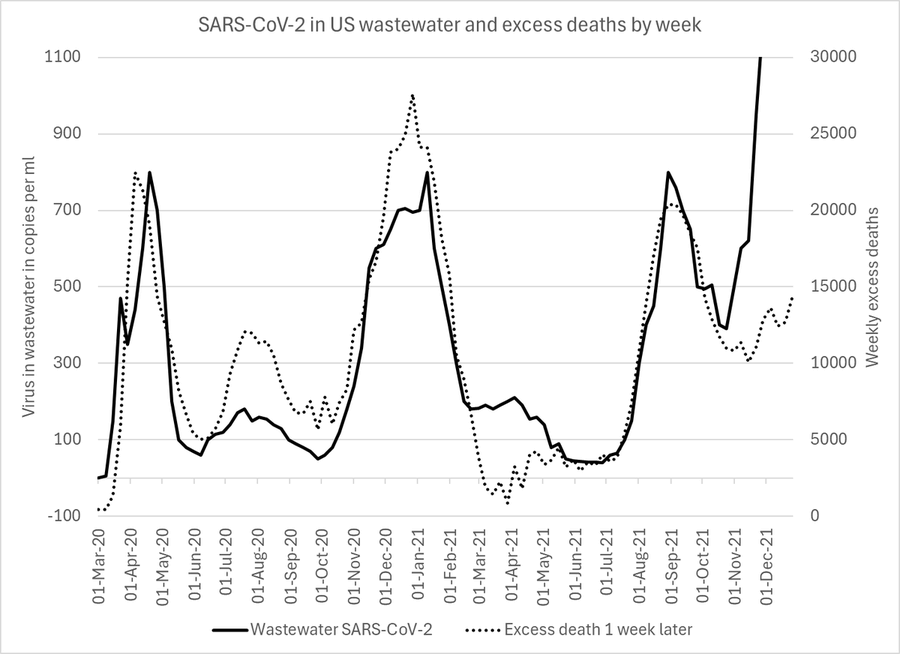
Also, there is no low vaccination country that saw the threatened death tsunami that the models claimed should have occurred.
Importantly, OSR declined to comment on the suitability or accuracy of the modelling itself, stating that this lay outside its remit.
A Regulatory Vacuum
This creates an unusual situation.
The Covid Inquiry can present highly consequential model outputs in headline form, while the UK’s statistics regulator simultaneously states that:
- the presentation risks overstating confidence,
- the figures require clearer contextualisation,
- and the regulator itself is unable to assess whether the underlying analysis is reliable.
The result is that some of the most politically significant numbers of the pandemic era exist in a kind of regulatory vacuum: influential enough to shape public understanding, but insulated from meaningful statistical challenge.
Scientific models can be useful tools. But models are not observations, and estimates are not historical facts.
This is how history gets rewritten.
Appendix
Here is our letter and the response in full:
Dear Ed Humpherson,
On 19 February 2026, your office wrote to the UK Covid-19 Inquiry regarding its Module 2 report.[1] You noted that the Inquiry’s presentation of modelling risked being “a misleading representation of the underlying analysis.” You shared your findings, you explained, because in future modules the Inquiry “may wish to present modelling or other analytical evidence and it will be important that this is communicated clearly and accurately.”
The Module 4 report, published this week, does the same thing with a number twenty times larger.[2]
The report presents as a finding that vaccination saved 475,000 lives in England and Scotland and 7,000 in Wales. This figure is not an observation. It is the output of a WHO model that depends on assumptions about what would have happened without vaccination.
These assumptions are not consistent with the available surveillance data. PHE and UKHSA household contact tracing data showed that approximately 10–11% of contacts acquired infection per wave. That figure did not change between the pre-vaccination and post-vaccination periods. To achieve the claim of 482,000 lives saved the model assumes a level of susceptibility that is more than eight times as high.
The estimate is also derived from observational studies susceptible to the healthy vaccinee effect, whereby individuals near the end of life are less likely to be vaccinated. This is not a theoretical concern: Public Health England’s own data showed a reduction in covid-19 mortality within the first 14 days of vaccination (HR 0.74), a period too early for a biological vaccine effect, indicating measurable bias in the underlying data.[3] A study from Qatar specifically designed to assess the healthy vaccinee effect reported substantially lower non-covid mortality among vaccinated individuals (HR 0.35) in the first six months following two doses, consistent with a pronounced healthy vaccinee effect.[4]
The figure also exceeds what is arithmetically possible under the Inquiry’s own prior modelling. The original unmitigated scenario projected up to 500,000 UK deaths. Around 150,000 were recorded. The Inquiry now attributes 482,000 lives saved to vaccination in England, Scotland, and Wales alone. That is more than the entire gap between modelled and observed deaths, and before accounting for any lives the Inquiry attributes to lockdowns.
Your office has already established the principle that the Inquiry should not present modelled estimates as established facts. I would be grateful to know whether you consider that principle to apply equally to the claims in Module 4.
Yours faithfully,
Dr Clare Craig and Dr Ros Jones
Co-chairs HART
References:
[1] Humpherson E. Presentation of modelling in the Module 2 report of the UK Covid-19 Inquiry [letter]. Office for Statistics Regulation; 19 February 2026 https://covid19.public-inquiry.uk/documents/letter-from-the-office-for-statistics-regulation-dated-19-february-2026-about-the-presentation-of-modelling-in-the-module-2-report/
[2] UK Covid-19 Inquiry (Chair: Baroness Hallett). Vaccines and therapeutics (Module 4) report. London: UK Covid-19 Inquiry; 2026. https://covid19.public-inquiry.uk/documents/module-4-full-report/
[3] Public Health England. COVID-19 vaccine effectiveness report: March 2021. London: PHE; 2021. https://assets.publishing.service.gov.uk/media/60ae0dbed3bf7f73893a8ea6/PHE_COVID-19_vaccine_effectiveness_report_March_2021_v2.pdf
[4] Chemaitelly H, Ayoub HH, Coyle P, et al. Assessing healthy vaccinee effect in COVID-19 vaccine effectiveness studies: a national cohort study in Qatar. Elife. 2025 Jun 9;14:e103690. doi:10.7554/eLife.103690. https://pubmed.ncbi.nlm.nih.gov/40488740/
Dear Dr Clare Craig and Dr Ros Jones,
Thank you for contacting the Office for Statistics Regulation (OSR) regarding the presentation of modelling in the Module 4 Report – Vaccines and Therapeutics published by the UK Covid-19 Inquiry.
As stated in our 19 February letter to the Inquiry regarding the Module 2 report, the Inquiry’s reports do not fall within OSR’s statutory remit. Our previous consideration of this matter has been on a strictly advisory basis. While our recommendations to the Inquiry regarding the presentation of figures in its Module 2 report remain relevant and applicable across its reporting, we cannot require the Inquiry to follow a particular course of action or amend its findings. With that in mind, we were grateful for the Inquiry’s informative and transparent response to our previous letter. We have reviewed your concerns about the presentation of modelling in the Module 4 report within this context.
Your email to OSR raised concerns regarding paragraph 5.5 on page 112 of the Module 4 report, the text of which I have copied below:
“Analysis of data from the World Health Organization estimated that, by March 2023, the lives of about 475,000 people aged 25 years or older had been saved as a result of Covid-19 vaccinations in England and Scotland. In Wales, the number of lives saved was estimated to be about 7,000 by June 2022.”
You were concerned that the report presents the 475,000 and 7,000 figures as findings of the Inquiry. We have reviewed the report, and we note that the use of the word “estimated” in this paragraph indicates an estimate based on modelling, rather than a directly observable figure. The source of this estimate is referenced in the report’s footnotes as being analysis of WHO data in the Expert Report for the UK Covid-19 Public Inquiry – Module 4. This report contains the guidance in paragraph 4.38 that “These estimates are based on mathematical models, and therefore limited by the underlying assumptions of the models used”. Taken together, this information provides important context for the reader around the published sources for the figures, including that they are drawn from modelled estimates.
The use of the word “estimated” in the report’s main body, alongside the information contained in the footnote, is sufficient to guide the reader to understand the figures, but the presentation could be further strengthened to make the source and context of the figures clearer. Therefore, we have suggested to the Inquiry team that they may want to consider how readers can be further guided to understand different types of statistical evidence in future reports. This is in addition to our previous guidance about the importance of not overstating confidence in statistical models in reporting, especially when such estimated figures resulting from modelling are presented in the same report as observed figures.
We have noted your additional concerns that the assumptions in the WHO model employed in the Expert Report analysis are not consistent with the available surveillance data. As the regulator of the UK’s official statistics, beyond advising on the transparency and accessibility of the analysis, it would not be appropriate for us to comment on the suitability, quality or accuracy of this analysis for the Inquiry’s needs. You may therefore wish to raise this matter with the Inquiry secretariat directly.
Thank you for contacting us about this matter.
Ed Humpherson
Sent on behalf of Ed Humpherson, Head of the Office for Statistics Regulation
Chris Ferrier