

MTHFR gets the attention but DHFR is slow in everybody.
Dr Clare Craig
Ask why folic acid might be a problem and the conversation arrives at MTHFR within a few minutes. Have you been tested? Do you carry the variant? Should you be taking methylfolate instead?
There is actually another gene that we should be more concerned about.
The MTHFR issue
MTHFR converts a folate intermediate into 5-methyltetrahydrofolate, the form the body uses to enable methylation of genes to switch them on and off. The C677T variant of MTHFR produces an enzyme that is unstable. In European populations around 45 percent of people carry one copy and about one in ten carries two. The latter are the ones that show metabolic differences. This variant form falls apart into monomers and loses its flavin cofactor more readily. Without that cofactor it does not work. Because it does not work, people with two copies do not produce enough 5-methyltetrahydrofolate and therefore have reduced ability to methylate their genes. Without enough 5-methyltetrahydrofolate, homocysteine cannot be recycled onwards into methionine and it builds up.
Folic acid can actually reduce this build up of homocysteine. The same American cohort before and after fortification showed the range in homocysteine between genotypes fell from 2.5 micromoles per litre to under 0.7. The proportion of people with both genes as MTHFR variants who had moderately raised homocysteine fell from 33 percent to 12. Folic acid was presumably driving the enzymes to work harder by increasing the upstream inputs. Whether that is entirely beneficial is a separate question.
Folic acid also acts directly on the MTHFR enzyme itself. When mice with normal genes were fed folic acid for six months it inhibited MTHFR activity directly, and the amount of MTHFR protein in the liver fell by around 40 percent. The researchers named the result a pseudo-MTHFR deficiency.
When mice with the MTHFR variant were fed folic acid there was no beneficial drop in homocysteine but there was little detriment either. However, folic acid lowered liver MTHFR protein, lowered the methylation ratio (i.e. the enzyme’s activity) and increased fatty liver in the wild-type females. The damage occurred in the animals without the variant. The human research is awaited.
There is a difference between human and mice in terms of homocysteine production in those with MTHFR variant. Humans are not mice. Also the mice were never short of folate which was not necessarily true of all Americans. A shortage of folate leads to raised homocysteine and folic acid lowers it but if it was not raised it would not be lowered.
The fact that folic acid can alter the function of MTHFR is itself interesting. Folic acid circulates and has these effects because of another enzyme which takes time to convert it into usable folate.
The enzyme that is slow in everyone
It takes fifteen minutes to convert a certain amount of natural reduced folate in the gut wall to 5-methyltetrahydrofolate which can be used by MTHFR. However, after fifteen minutes of the equivalent dose of folic acid, 80 percent was still unmodified folic acid and it was passed on to the liver. It is the dihydrofolate reductase enzyme or DHFR, predominantly in the liver, which ends up converting folic acid slowly into folate.
Human DHFR is on average some 56 times slower than the rat’s at processing folic acid. The safety studies on folic acid have all been done on rats. Worse, between individuals the rate varied about fivefold.
A single oral dose above roughly 260 to 280 micrograms is enough to exceed the liver’s capacity to process folic acid. Remember, the minimum that must be contained in 100g of non-wholemeal flour as part of the UK mandate is 250 micrograms. When volunteers were fed fortified cereal and bread unmetabolised folic acid was found in the blood if the food contained above about 266 micrograms.
The Scientific Advisory Committee on Nutrition recorded that the capacity of the gut mucosa is limited, that single doses above about 260 micrograms can put unmetabolised folic acid into the systemic circulation, and that the long term biological effects in humans are unknown in their 2006 report that recommended fortification.
When four volunteers were given 1,000 micrograms divided up into portions of varying sizes down to ten separate doses of 100 micrograms, unmetabolised folic acid still appeared in the blood. In fact, unexpectedly, it was most marked when the total was broken into the smallest portions. When the dosage was restricted to 200 micrograms a day in total the unmetabolised folic acid did not appear.
What is left in the blood
When a random sample of 2,700 Americans had their blood measured for unmetabolised folic acid it was detectable in 96 percent of those taking no supplement and 98 percent of those taking one. Detection was near universal whatever the age, sex, ethnicity, supplement use or fasting status. Concentrations above one nanomole per litre were present in a third of the population and even in a fifth of adults who had fasted for eight hours or more. The CDC authors infer that chronic exposure at the doses fortification delivers may saturate the pathway.
The higher concentrations were commonest in children, in 41 percent of those aged one to five and 45 percent of those aged six to eleven, compared with 23 percent of adults in their twenties and thirties. A small child’s folate requirement is a third to a half of an adult’s while children’s intakes ran to about two thirds of adults’.
In one study from China, unmetabolised folic acid (UMFA) was detectable even at 400 micrograms daily and rose progressively thereafter. Above 800 micrograms a day, each further 200 to 400 micrograms added roughly four times as much UMFA as the same increment below it, while 5-methyltetrahydrofolate levels flattened. Above 800 micrograms more folic acid produced more of the unconverted molecule and no more of the usable one. The authors concluded that 800 micrograms a day is enough to saturate the human capacity to convert folic acid. Which MTHFR or DHFR variant a person carried made no difference to the relationship. The saturation occurred in everyone.
There are therefore two different measures of saturation point. The 260 to 280 microgram threshold is the largest single dose the liver can clear. The 800 microgram figure is the daily total for a steady intake where more folic acid stops producing any more usable folate. Both are caused by a slow enzyme.
Clearly with a fivefold variation between individuals the actual upper limits will vary considerably person to person. The reason for the wide variation on capability of this enzyme has not been established.
The variant in DHFR itself
There is less known about what causes the wide variation in DHFR activity compared to MTHFR. A common 19 base pair deletion of part of the gene varies markedly in frequency between populations. Those with two copies had more unmetabolised folic acid in plasma and less folate in the red cells. On a normal diet there is no difference based on this enzyme but people taking more than 500 micrograms of folic acid a day showed a difference in UMFA and folate stores. Ultimately, the effect of this one deletion on the enzyme has not been demonstrated. The fivefold spread between individuals may be due to something else altogether.
There are therefore two enzyme bottlenecks. DHFR is key because it determines how much folic acid stays unmetabolised as a drug in the blood. That is an issue for everyone and the problem is worse with every increase in dose. MTHFR variants determine how efficiently the reduced folate is then methylated for use in gene switching.
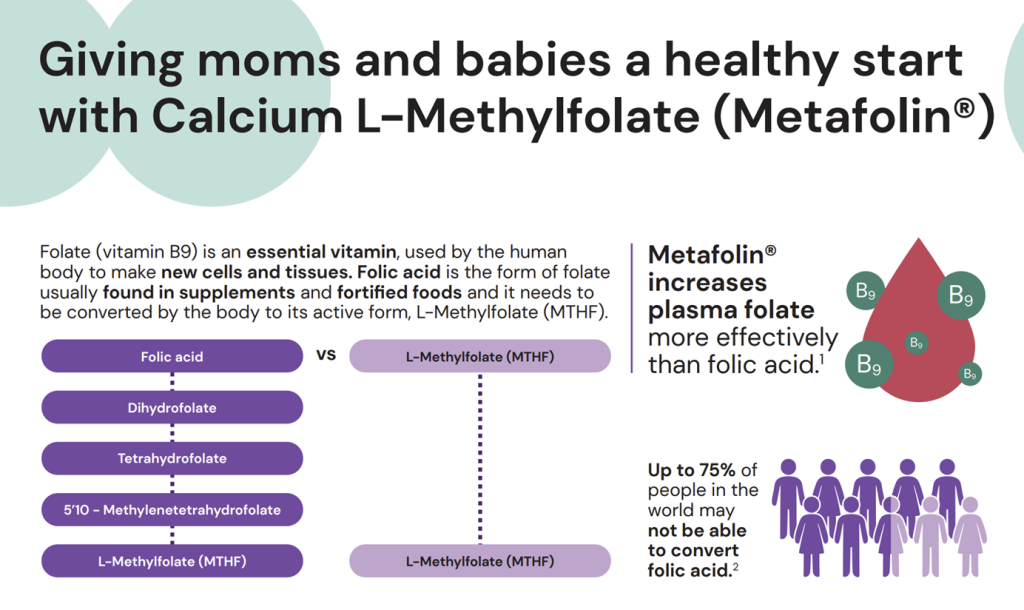
Figure 1: DSM-Firmenich infographic
The manufacturer makes the same move. DSM-Firmenich, the largest Western manufacturer of folic acid (it bought Roche Vitamins in 2003), makes folic acid and sells it for adding to flour, salt, breakfast cereals, drinks and infant formula, although most of the world’s folic acid is made in China. It also sells Metafolin, a methylfolate ingredient for prenatal supplements, which by its own account is made from its folic acid. The infographic for it sets the conversion chain out correctly, folic acid through dihydrofolate and tetrahydrofolate to methylfolate, with the natural form entering ready to use. Alongside that it states that up to 75 percent of people in the world may not be able to convert folic acid. The reference given for that figure is a review of MTHFR variants in cancer chemotherapy, which concludes that the evidence remains quite uncertain. Carrying a common variant in the last enzyme of that chain is not the same as being unable to convert folic acid. In commercial terms, the manufacturer sells folic acid in food for the majority then tries to upsell methylfolate on the premise that folic acid is not a good idea after all.
The difficulty is not specific to a subgroup with a genetic variant. The first reduction step folic acid requires is unusually slow in all humans as well as varying markedly between individuals. Unmetabolised folic acid enters the circulation at ordinary oral exposures in a fortification setting, including when smaller doses are repeated across a day, and it is still detectable in a substantial minority after a long fast. None of that depends on MTHFR genotype. Folic acid interferes with MTHFR whatever version of it a person carries and it can do so because DHFR left it circulating.