

What is the evidence?
Dr Clare Craig
There has never been a trial designed to determine the safety of folic acid at any dose, let alone specifically focused on fortification doses. The evidence that exists is always second hand from trials designed to show a benefit; includes other vitamins alongside folic acid and uses doses higher than the fortification dose. The effects of drugs differ by dosage so what happens at a high dose may be different to what happens at a low dose. The limited trial data that exists for people with heart stents is concerning as explained below.
Earlier this year the NHS removed from its warnings on “who cannot take folic acid” the words “if you…have a stent in your heart”. Asked in Parliament why, the minister defended the cut saying the page had been shortened and simplified. The warning has since been restored. The live NHS page again lists a coronary stent among the circumstances in which folic acid “is not suitable”.
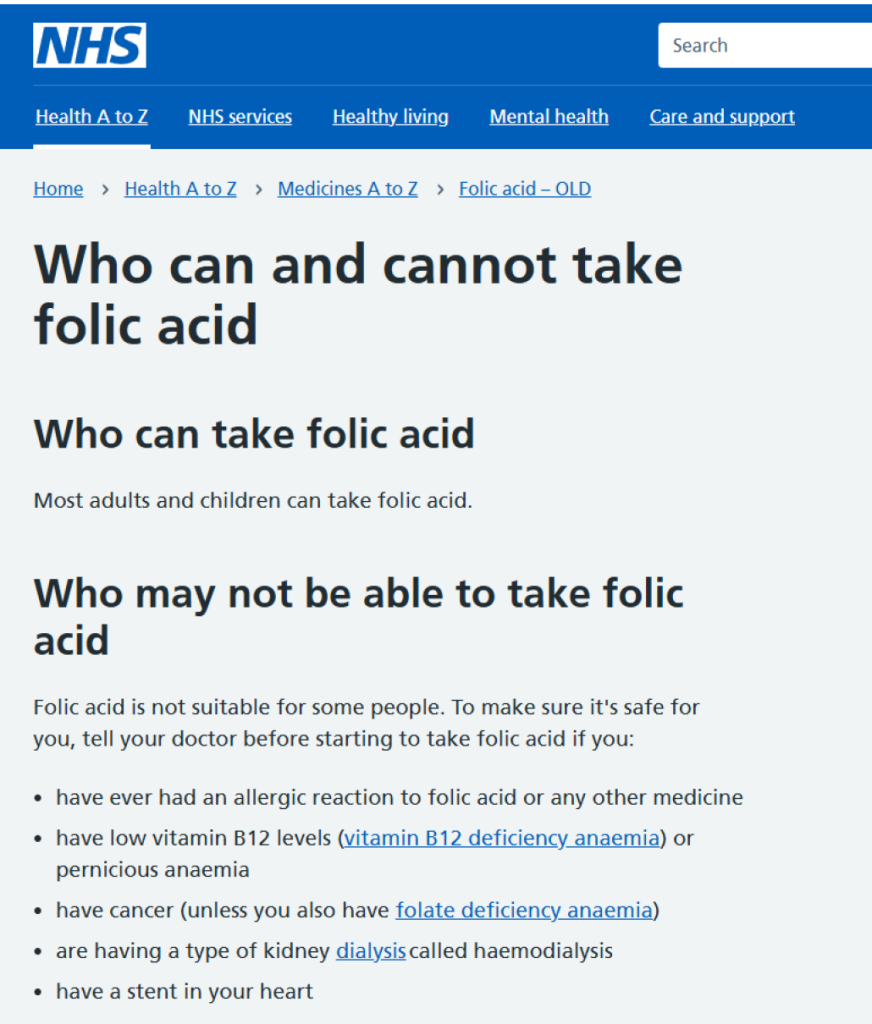
Figure 1: NHS website advice before amendments saying “have a stent in your heart”

Figure 2: NHS website advice after amendments to shorten and simplify saying “you have a coronary stent (a small metal mesh tube inserted into the artery that leads to your heart)”
A similar caution can be found in the product information details published by the drug regulator. The Summary of Product Characteristics from 2018 for Folic Acid at a 5mg dose states that folic acid (which they called folate) “should not be routinely used in patients receiving coronary stents”.
The evidence base for that caution comes largely from a randomised trial published by Helmut Lange and colleagues in 2004. Between 1998 and 2000, 636 patients who had just received a bare-metal coronary stent were allocated to placebo or to an intravenous bolus of 1mg of folic acid along with 5mg of vitamin B6 and 1mg of vitamin B12. They were then given six months of oral folic acid at 1.2mg a day along with 48mg of vitamin B6 and 60µg of vitamin B12. The expectation was that giving vitamins would be beneficial to the patients and it was part funded by the vitamin manufacturer. It did not prove beneficial.
The participants had a follow-up angiogram to measure the narrowest point of their heart vessels. The treatment group had a smaller minimum luminal diameter and the change in the size of the lumen since the procedure was also worse for them. Both findings were clearly statistically significant, at p=0.008 and p=0.004. These are the most convincing results and are both measures the trial set out to measure.
Overall, a narrowing of half or more of the blood vessel diameter, which is the definition of “restenosis”, had occurred in 34.5 percent of lesions in the treatment group compared to 26.5 percent in the placebo group. That amounts to a 30 percent increased risk, at p=0.05, the threshold for conventional statistical significance.
The study also measured interventions that occurred before the follow up angiography. At 165 days a repeat intervention to revascularize the treated vessel had been needed in 7.6 percent of the treatment group compared to 4.4 percent of the placebo group, which was not statistically significant. By 250 days, after the follow up angiography and counting procedures that were undertaken because of findings from it, the figures were 15.8 percent compared to 10.6 percent, again at p=0.05 and again on the threshold. Major adverse coronary events, which included these interventions as well as heart attacks and death, were 16.8 percent compared to 10.9 percent at 250 days, at p=0.03. Deaths (one in each arm) and infarctions (3 vs 2) were too few to see a noticeable difference.
The study needed to be larger to get a full understanding not least because the follow-up angiography was undertaken by only 76 percent of participants. The authors of this industry sponsored study (which kept referring to folic acid as folate) concluded
“Our data do not provide any evidence that folate therapy for the primary or secondary prevention of coronary artery disease is potentially harmful, since the folate group did not have an increased incidence of death or infarction… If, however, physicians decide to administer folate therapy to patients with coronary artery disease and moderate hyperhomocysteinemia even before the results of prospective prevention studies are known, they should exercise caution in the use of this therapy for patients who have just received a stent.”
The trial was not restricted to that group of patients and the caution therefore should be wider.
As well as being too small the trial gave three vitamins together, included intravenous dosing and used bare metal stents which are now a small minority of what is implanted. Metal stents were replaced by drug-eluting stents which work by releasing a drug whose purpose is to suppress the growth of new cells inside the stent. Whether folic acid interacts with those drugs has never been studied.
The Lange study was undertaken after results of a Swiss trial suggested a benefit. The Swiss trial, published in 2001, gave 205 patients the same three vitamins after angioplasty. They found restenosis in 19.6 percent of the treatment group compared to 37.6 percent in the placebo group. Only just over half of those patients had a stent. In the stented subgroup the difference was 20.6 percent in the treatment group compared to 29.9 percent in the placebo group and was not statistically significant.
A 200-patient Iranian trial is the only one to have tested folic acid alone. It found restenosis in 10 percent in the treatment group compared to 5 percent for the placebo group but was too small to reach statistical significance.
A Norwegian trial, NORVIT, gave 3,749 patients who had just had a heart attack one of four daily treatments:
- 0.8mg of folic acid with 0.4mg of vitamin B12 and 40mg of vitamin B6;
- folic acid with B12;
- vitamin B6 alone; or
- placebo.
The negative outcomes that were measured included fatal or non-fatal heart attack, fatal or non-fatal stroke, and sudden death attributed to coronary heart disease, over a median of 40 months. Patients on all three vitamins had a 22 percent higher risk. The authors concluded:
“the NORVIT trial demonstrated that intervention with folic acid, with or without high doses of vitamin B6, did not lower the risk of recurrent cardiovascular disease or death after an acute myocardial infarction. Such therapy may even be harmful after acute myocardial infarction or coronary stenting and should therefore not be recommended.”
A second Norwegian trial, WENBIT, was running in parallel. It recruited 3,090 patients on the identical four-arm design. When preliminary results were presented from NORVIT in September 2005 they raised a possible increase in cancer. The following month WENBIT stopped its treatment early, which shortened the exposure it was able to test.
A substudy of WENBIT reported on the effect after stenting. Of 456 eligible participants, 365 had detailed measurement of their arteries by angiography at six to twelve months, including 509 bare-metal stents. Restenosis occurred in 17.9 percent of lesions with no difference between the groups. This is the strongest evidence against a harmful effect. It was presented at the World Congress of Cardiology in 2008. Eighteen years later there is still no publication of the full results.
A later substudy from the same trial also found no significant difference between the groups in how the arteries changed overall. However, a difference was seen in “rapid progression” of the unstented lesions in the treatment group in an analysis carried out after the event. It was published in the American Journal of Cardiology in 2010. Oddly, in this peer reviewed publication they did not report the restenosis rate or the ultrasound measurement of the narrowing.
All the trials above gave between 800-1200 µg a day. For the majority, flour related exposure is expected to be lower than this. A lower dose cannot be assumed to be safer. Drugs have different effects at different doses and each dose needs to be studied in its own right.
It is high time that a large safety study of folic acid at fortification doses was carried out to measure outcomes that matter, like heart attacks and death. There is no intention to do that. Instead almost the whole UK population is going to be exposed through the mandatory addition of folic acid to flour, which removes the one thing such a study would need: a comparable group of British consumers who are not exposed.
Was there a change in restenosis rates when countries added folic acid to flour?
If there really was a signal then the data on restenosis rates should show it. However, any comparison over time is a problem because of numerous changes over the same time course. The first is that the stents themselves changed, from bare metal to drug-eluting and further upgrades, each cutting restenosis risk. The stented population themselves have aged, have more diabetes and more complex heart disease. Comparisons between countries are hampered by differing definitions of what is recorded in the data. There are measures of all procedures treating a narrowing of a stented lesion but these cannot be compared to a count of procedures for any kind of restenosis. Also, some countries report as a percentage of all interventions done, which itself could change over time, while others give absolute numbers of interventions.
What has not been researched
Any registry analysis of restenosis across a fortification date, adjusted for stent generation and case mix
A randomised trial of folic acid alone, at a fortification-relevant dose, in patients receiving modern drug-eluting stents, with identical angiographic follow-up in both arms
Folic acid alone at doses below 1 mg a day in stented patients, at any stent generation
Interaction between folic acid and the antiproliferative drugs released by drug-eluting stents
Unmetabolised folic acid measured at the time of stenting and related to restenosis at follow-up, which no stent study has done
Restenosis in carotid, renal, peripheral or intracranial stents in relation to folic acid intake
The effect of folic acid exposure lasting longer than the six months Lange measured
Whether Lange’s subgroup pattern, with harm concentrated in men, in those without diabetes and in larger vessels, is real or chance
A full publication of the WENBIT stent result, which remains a conference abstract eighteen years on
Any registry analysis of restenosis across a fortification date, adjusted for stent generation and case mix