

What an FOI revealed
Dr Clare Craig
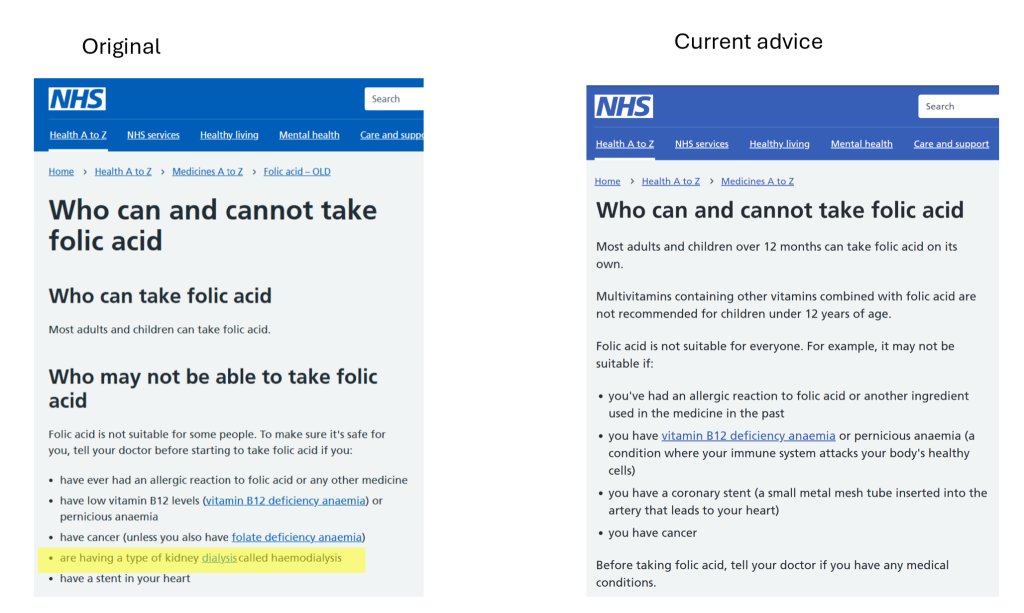
The NHS has altered its online advice as to who must avoid folic acid right before it is mandated in our staple foods. Internal records show a warning to people on dialysis was cut because staff found it “confusing”. A warning that people with heart stents must avoid it was reinstated only after a member of the public refused to accept the NHS’s explanation for its removal.
NHS England has published the internal papers behind its 2026 rewrite of the public folic acid page. A Freedom of Information request had asked three things:
- why two cautions had gone from the old page, one about haemodialysis and one about coronary stents;
- who signed off the changes;
- and whether anyone outside the editorial team had been asked.
The papers show that one of the two warnings was cut on purpose, because staff found the evidence “confusing”. The other went with no recorded reason at all, and came back only after a member of the public pushed back on the NHS’s standard reply.
“Created from scratch”
NHS England says the page was “created from scratch” in a redesign meant to shorten and simplify its medicines information. Instead of listing every precaution, the new pages give only “some examples” and point patients to the manufacturer’s leaflet for anything more.
The documents released under FOI tell a more complicated story. The original website was clearly being edited with important specific cautions discussed and removed. The advice to dialysis patients was discussed over and then cut on purpose. It was not lost in the wash of a rewrite.
Haemodialysis
The old page said folic acid “may not be suitable” for people on haemodialysis. In the tracked draft released under FOI that wording is carried across into the new version before being struck through.
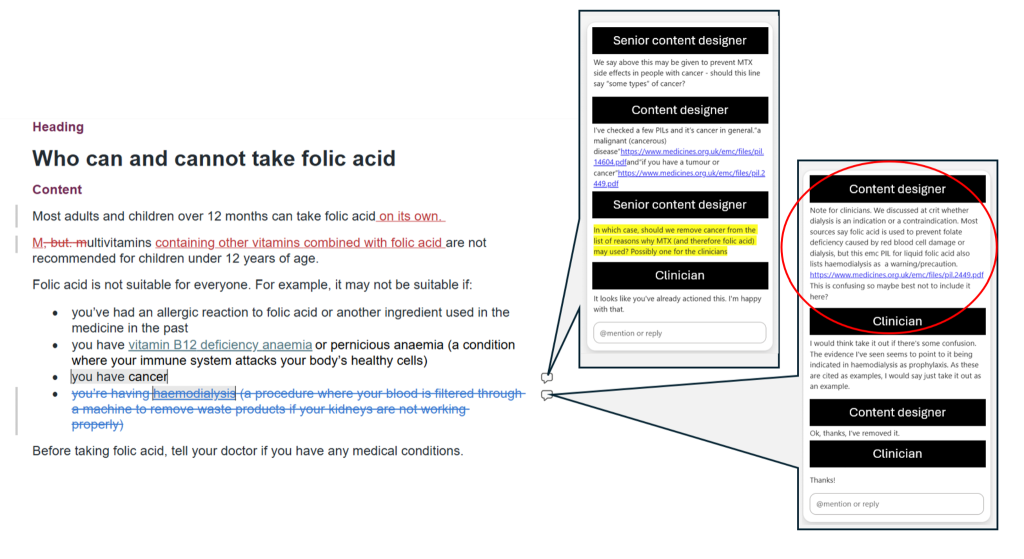
The recorded exchange sets out why. A content designer noted that some sources treat dialysis as a reason to prescribe folic acid, while a licensed patient information leaflet lists haemodialysis as a precaution, and wrote: “This is confusing so maybe best not to include it here?” A clinician replied that folic acid is used in dialysis to replace folate lost during treatment and that the example could be dropped.
That reply is where the reasoning breaks down. The deletion rested on folic acid being prophylactically indicated in dialysis. It is not. Routine folic acid supplementation is not standard dialysis care. Patients who become folate deficient can be identified on routine blood tests and treated if necessary.
Folic acid is not benign in this group either. In the DIVINe trial, patients with diabetic kidney disease given folic acid with vitamins B6 and B12 lost renal function faster than those on placebo, and had around twice the rate of vascular events like heart attacks and stroke, and death. The HOST trial of a massive dose of folic acid along with other vitamins in advanced kidney disease also found more deaths in the treated group but this was not statistically significant. Although these trials used higher doses than those expected from food fortification, neither demonstrated clinical benefit and one found worse renal and cardiovascular outcomes. The evidence-based course is to watch for the tiny minority who become depleted, which shows up easily on the commonest of blood tests and treat only those patients.
The original warning that dialysis patients should be cautious about folic acid should remain. The argument that a tiny proportion with a specific diagnosis of anaemia caused by folate deficiency might need the drug folic acid to treat it, is true for the entire population.
Coronary stents
For the coronary stent warning, the papers carry no recorded discussion at all about taking it out.
The contrast with the clear record keeping of the removal of the advice on haemodialysis is striking. Under the Freedom of Information Act, NHS England had to release the recorded information it held about the change – all emails, meeting minutes and discussion. On the stent removal it produced nothing at all. That means either that no reasoning was ever recorded or that the response failed to disclose it. Nevertheless, the line about stents was removed.
The original caution had an evidential basis. The FACIT trial randomised 636 patients after coronary stenting to folic acid with vitamins B6 and B12, or to placebo. It found significantly higher rates of restenosis and repeat revascularisation in the folic acid group. That would have meant an emergency restenting procedure for some, a heart attack for others and, ultimately, a risk of death (an outcome that this trial was too small to measure). Folic acid is dangerous for these patients, not merely unsuitable.
When a member of the public asked why the warning had gone, NHS England first said the page had only been “simplified”. When Esther McVey MP asked a question about this, the Parliamentary Under-Secretary of State for Public Health and Prevention, Sharon Hodgson MP replied: “This new format is shorter and simpler than the legacy medicines topic pages, making them more accessible and easier to maintain, decreasing risk. As NHS England cannot provide definitive advice for all patients in all situations, instead patients are encouraged to read the relevant Patient Information Leaflet and to consult a physician if they have any existing medical condition.” This was the second time she acknowledged that folic acid was a drug requiring a patient information leaflet.
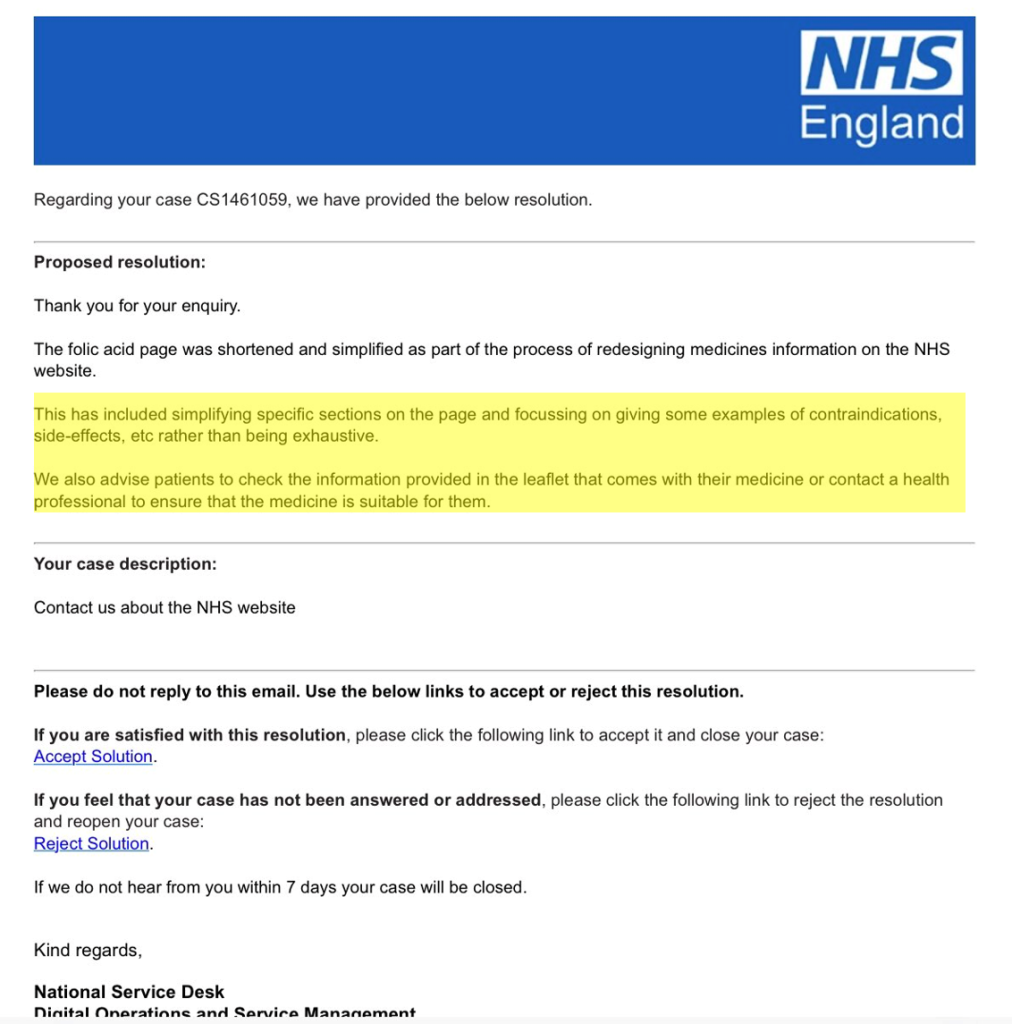
After further push back, the live page was changed.
“Thank you for your recent comments about the folic acid medicine page on the NHS website. Following your feedback, I have updated the page with a bullet point about coronary stents and have made it clear that folic acid may not be suitable for someone with a stent. You can see the updated page at the link below: www.nhs.uk/medicines/folic-acid/ Many thanks once again for bringing this matter to my attention.”
It again lists a coronary stent among the reasons folic acid “may not be suitable”, and the officer who made the change confirmed that folic acid “may not be suitable for someone with a stent”. This is far weaker wording than the evidence supports. People with stents must avoid folic acid. The government in response to the active parliamentary petition themselves said: “The NHS provides guidance for individuals who may need to avoid folic acid, for example, due to specific medical conditions or interactions with medication. People in this situation are advised to seek advice from a healthcare professional.”
The restoration of the warning undermines the earlier explanation that it had simply been omitted to simplify and refer people to patient information leaflets (which food products do not have).
I have written to ask them to clarify if the full information on discussions about the removal of the stent advice has been shared.
No outside scrutiny
NHS England confirmed that no outside organisations were consulted during the rewrite. The changes were made entirely inside the website’s own editorial and clinical review.
From December 2026 folic acid will be added to ALL non-wholemeal wheat flour across the UK. It is already present in some wholemeal bread, gluten free bread, sausages, gravy granules, rice bowls, milk drinks, even potato products which contain flour are going to be mandated to have it in from December. There was no impact assessment of this legislation.
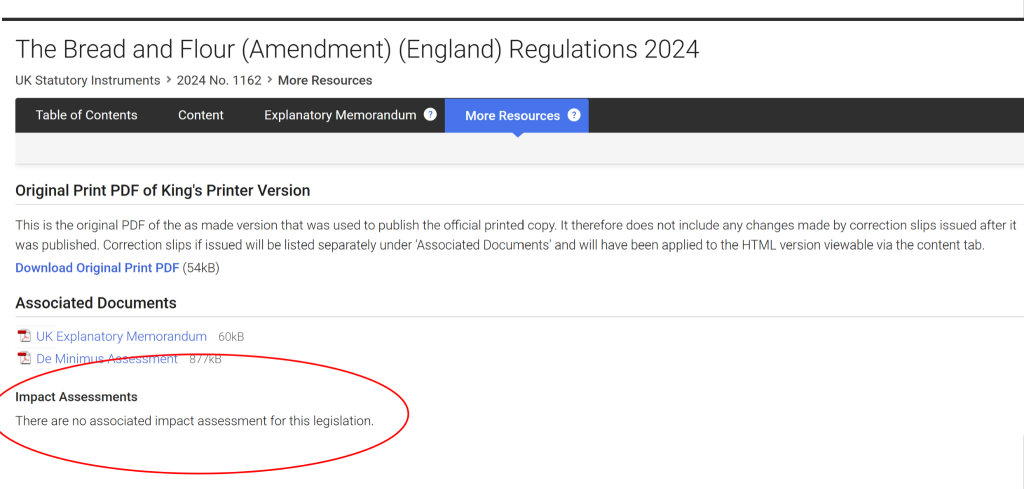
The Government prepared only a “de minimis assessment”, which by its own terms covers “the costs of business, the voluntary sector and the public sector” – not the effect on the people who will be eating the flour. The Government say it is still “exploring how we will evaluate the impact of the policy”, which means there is no system in place to detect who it harms.
Once folic acid is added to nearly all non-wholemeal flour, people can no longer avoid exposure simply by declining a tablet. That makes the accuracy and completeness of public information more important than ever. Yet the NHS’s own internal records show serious safety warnings being removed without discussion or because they were considered “confusing”.
The Government says the NHS tells people who should avoid folic acid. This FOI shows those warnings were being removed just months before folic acid is added to the nation’s food.