

The government said it would tolerate the law being broken.
Dr Clare Craig
Mandatory folic acid fortification of non-wholemeal wheat flour does not come into force until 13 December 2026 but folic acid has been in the food supply for some time without anyone being informed.
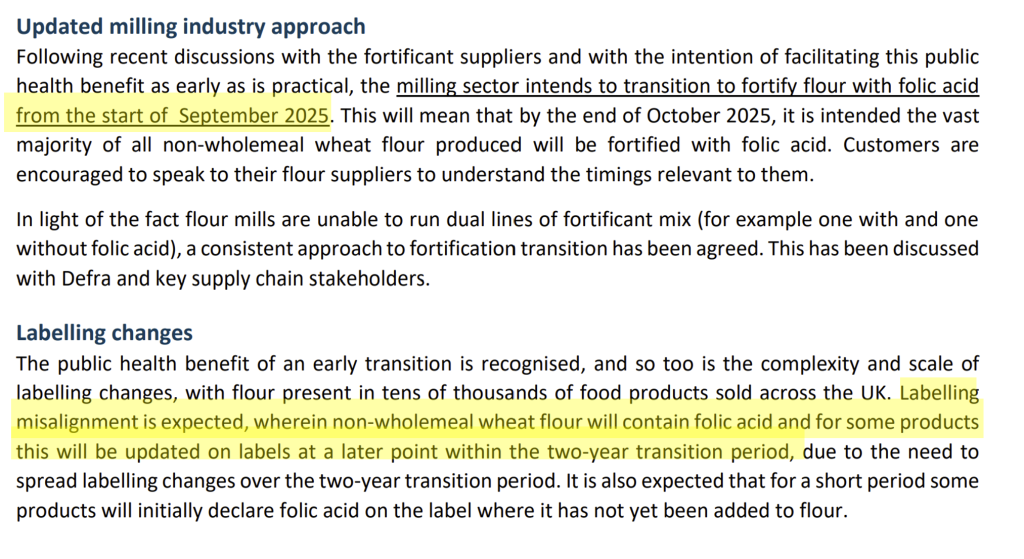
Millers began fortifying flour in September 2025 and by the end of October the vast majority of non-wholemeal wheat flour contained folic acid. That flour has been in bread, cakes, biscuits, batter and thousands of other foods ever since. The labels did not keep up.
The food industry’s own technical advisers told manufacturers that labels needed to change as soon as flour containing added folic acid entered the supply chain. The government said the same thing in 2022. There was no subsequent exemption from the labelling law. Instead, it was documented that it anticipated businesses would breach the law and told enforcement authorities to be proportionate about the resulting “non-compliance”.
The law was already clear
The law already requires prepacked food to carry a list of ingredients. The food labelling regulations state that “indication of the following particulars shall be mandatory: (a) the name of the food; (b) the list of ingredients”. They also state that the list “shall include all the ingredients of the food, in descending order of weight, as recorded at the time of their use in the manufacture of the food”. They further state that “food information shall not be misleading, particularly: (a) as to the characteristics of the food and, in particular, as to its nature, identity, properties, composition”. Government guidance confirms that vitamins and minerals added to flour must be declared in the ingredients list. Defra went further in its consultation response, saying that manufacturers would have to relabel products, “immediately after this is introduced in the product.”
The folic acid was added first
Industry were given two years to prepare for the December 2026 deadline. Millers chose not to wait and folic acid was added from September 2025.
They did not want to waste old packaging. Industry had already warned the government that some manufacturers held more than two years’ worth of packaging stock. UK Flour Millers’ own implementation document acknowledged what would result, “labelling misalignment is expected.”
The government knew consumers could be eating it unknowingly
In 2023, the Department of Health and Social Care asked the Food Standards Agency to assess the danger to people who might react badly to folic acid including from allergies when the folic acid in fortified flour was not declared on the packaging.
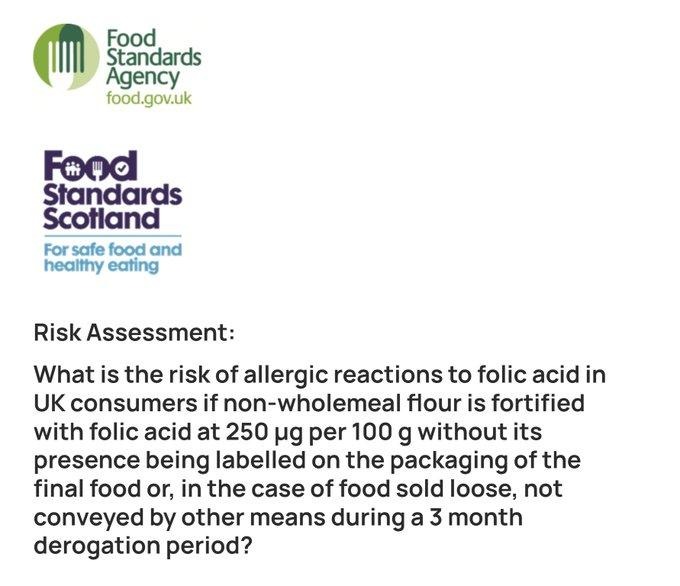
The FSA could not find data on how common hypersensitivity to folic acid was in the UK. There was no established allergen reference dose, meaning the standard method of assessing such a risk could not be used. It concluded that reactions would be very rare but could not be excluded, that their severity would be moderate and that there was medium uncertainty around its own assessment. Of course, there is no way of correlating what happened with this prediction because how would someone who had had a bad reaction know it was because of hidden folic acid?
Doesn’t the transition period allow this?
The obvious defence is that the new regulations contain a transitional provision. The regulations do not exempt labelling. The Explanatory Note describes a provision enabling “stocks lawfully placed on the market or labelled before 13th December 2026 to continue to be sold until exhausted”. The note is, in its own words, “not part of the Regulations”. The provision itself, the only transitional provision in the instrument, states that an enforcement officer “must not serve an improvement notice” where the notice “would relate to a product that was placed on the market or labelled before 13th December 2026” and “the matters constituting the alleged contravention would not have constituted an offence under the Bread and Flour Regulations as they applied immediately before 13th December 2026”. There is no mention of labelling, which is governed by the food labelling regulations and enforced separately under the Food Information Regulations 2014. Labelling law therefore still applies.
A formal labelling exemption was considered. In September 2023 the Committee on Toxicity recorded that transitional arrangements could mean a period of up to three months in which folic acid would not be reflected on the label, and that is what the FSA was asked to assess. No such compromise was written into the regulations. Instead we were left with enforcement discretion with no defined end date. The FSA assessment covered only three months. The unlabelled period began in September 2025 and a year on the issue with labelling continues.
From “immediately” to “proportionately”
In 2022, the government told consultees that manufacturers would have to change their labels “immediately” when folic acid was introduced into their products. It reassured consumers that existing labelling law meant they would know when folic acid was present. By March 2025 government guidance was instead discussing the expected “non-compliance”, how long it might last, how the risks might be mitigated and how enforcement authorities should respond to it in a graduated and proportionate way.
The law had not changed and there was no new exemption. All that changed was the government’s willingness to enforce the law.
If the government is willing to tolerate inaccurate ingredient lists because changing packaging is inconvenient or expensive, the obvious question is who are they actually representing?