

When a claim becomes unfalsifiable it is no longer scientific
Dr Clare Craig
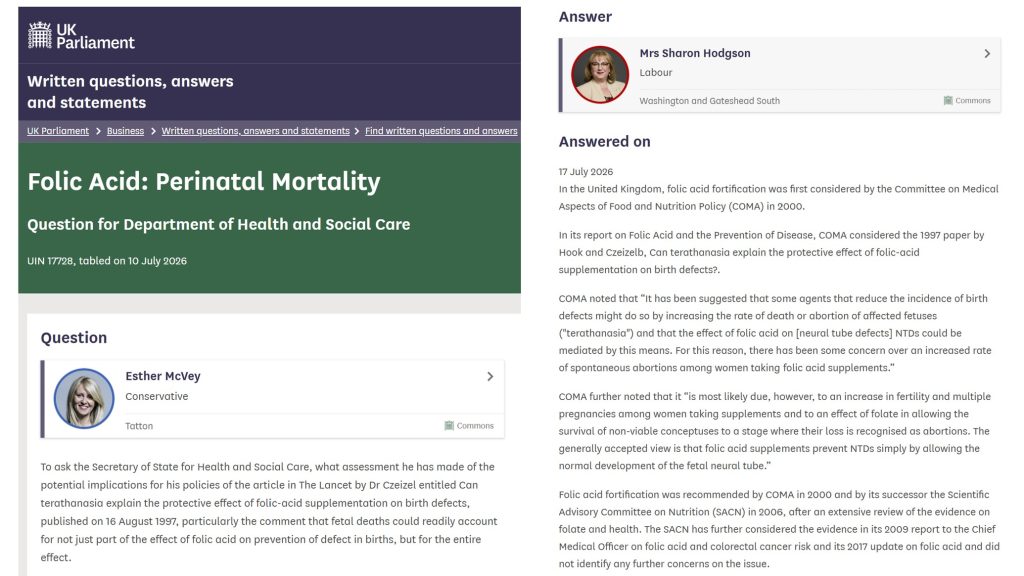
On 10 July 2026 Esther McVey asked the Department of Health and Social Care what assessment it had made of a 1997 Lancet paper by Ernest Hook and Andrew Czeizel. They tried to highlight the troubling possibility that the claimed reduction in babies born with neural tube defects could be accounted for by killing the affected embryos. The authors gave the mechanism a name, terathanasia, the death of the malformed. On the figures, they noted, fetal deaths could account for the whole of the apparent benefit and not merely a part of it.
Czeizel was the principal investigator of the only large randomised trial of folic acid in otherwise healthy women. It was this man who was responsible for the evidence base that justified recommending folic acid to healthy women. It was the same man and the same source of evidence that raised the terathanasia possibility.
Sharon Hodgson, the Parliamentary Under-Secretary of State for Public Health and Prevention, answered on 17 July. In it she referenced the 2000 government COMA report, which had considered the same concern but set it aside. It claimed that the excess of miscarriages in the trial was most likely explained by higher fertility, more conceptions and by folic acid extending viability of early conceptuses such that they survived long enough to be recorded as a miscarriage rather than just a heavy period. They concluded that folic acid firstly cured the neural tube defect in those affected and then that it did not cause miscarriages but rather was responsible for an excess of life creation such that miscarriages were just a consequence.
It is a small masterpiece of a particular kind of intellectual but unscientific reasoning.
What a scientific claim is obliged to do
Karl Popper’s test for whether a claim belongs to science was whether any evidence could count against it. Whether evidence supported it was beside the point. A scientific hypothesis must be clear about which outcomes are not compatible with it – what would falsify it. This prediction is then tested and reality might break it.
When a statement is made that is compatible with every conceivable observation it is not scientific. If every apparent refutation is explained away and the belief carries on unchanged, then it was never a falsifiable hypothesis and is more akin to religious belief than science.
Judged by that test, the claim that folic acid saves babies has been placed beyond the reach of evidence. It has been protected twice over.
The first lock: unethical research
When Hook and Czeizel published, Judith Hall, one of North America’s most senior clinical geneticists, was quick to comment. She conceded in the Lancet that pathological examination of the lost pregnancies, to establish whether the dead embryos were in fact malformed, was “highly desirable”. She then observed that it would be “unethical to repeat the trials” warning that further discussion could interfere with an important public-health opportunity.
She acknowledged that there was one study capable of testing whether folic acid kills affected babies but in the next paragraph declared that very study unethical to run. Any scientist would insist on carrying out the experiment and properly measuring the effect. After all, the consequences are serious and have massive implications for population wide public health advice that had already been declared. But that very declaration had meant that the ability to question the belief that folic acid could only do good had ended.
The second lock: the good kind of dead babies
The concern from the trial was not minor. Every category of fetal loss was higher in the folic acid (plus multivitamin) arm and on a per-pregnancy basis the excess amounted to roughly nine fetal deaths for each neural tube defect prevented. This is the largest single finding in the trial.
The Government’s approach has been to rebrand these deaths. The lost pregnancies, it suggests, were non-viable conceptuses that were going to be lost in any case, merely surviving a little longer under folate before being counted. A good kind of dead baby, one whose life was extended thanks to the elixir of folic acid.
No evidence is supplied to back this up. However, if folic acid were merely shifting unnoticed early losses into the recognised-miscarriage column, the earliest losses should fall as they were promoted upward. They did not. The very earliest losses, the chemical pregnancies, rose alongside every other category. Once losses are counted as a rate per pregnancy rather than as a raw total, the excess of dead babies remains.
What it means for an individual mother
To achieve informed consent from a mother there are two key numbers she should be told. The first is the number needed to treat. On the trial’s own figures, roughly 440 women must take folic acid to prevent a single neural tube defect. The second is the number needed to harm. One in 50 of those women would suffer a lost pregnancy as a consequence. The harm is roughly nine times more likely than the benefit. That is the comparison every woman ought to be shown before she is given folic acid. Instead women are told it is safe and effective.
Where this leaves the policy
If a scientific hypothesis was put forward that folic acid was good for pregnancies then the kind of information that might falsify that position would surely include a reality where babies died as a result of exposure. When even that eventuality is reclassified as a benefit then we are no longer in a scientific realm. It is a doctrine, held in place by an ethical objection to the only experiment that could falsify it. In December 2026 that doctrine is made compulsory, not just for pregnant women but for us all with folic acid milled into our flour across the country. Public Health remains deaf to any criticism.